20 Jan 2026 — by Flawless Fine Jewellery — Reading time 12 minutes
The Oval Cut Guide
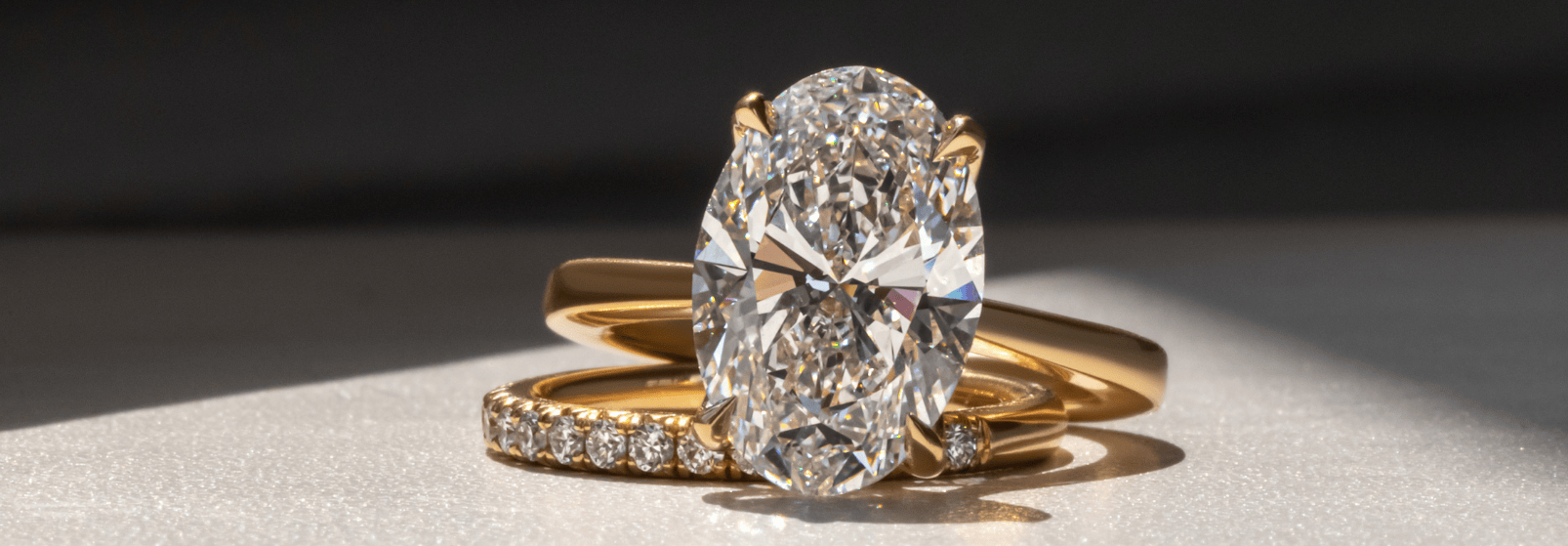
A complete guide to oval diamond rings, covering proportions, sparkle, grading, and why ovals appear larger
The Oval Cut Guide
What You'll Learn
➤ Everything you need to know about oval diamonds and why they've become a modern classic
➤ How to choose oval diamond engagement ring settings that amplify your oval cut diamond's beauty
➤ How the length-to-width ratio determines the anatomy of an oval cut diamond shape
➤ Why oval cut diamonds appear larger than round diamonds of the same carat weight
➤ Essential grading considerations for selecting an oval diamond, cut symmetry, clarity, and colour
There's a moment, when you first see the right oval engagement rings, where something just clicks. For many couples, that moment involves an oval diamond. Not because it's trendy. Not because it's what they're "supposed" to want. But because it feels like the first honest choice they've made about the whole thing.
An oval cut doesn't demand you fit into a mould. It bends toward you, your hand, your taste, your story. It's got the gravity of something timeless (your grandmother might have worn one), but it doesn't whisper that you should. Instead, it quietly says: you can have something classical and completely your own. That's where the magic lives. In that, permission to be yourself.
The Ovals had quite the comeback. Couples these days aren't buying into the idea that engagement rings need to look a certain way. They just don't. The oval cut says something: it's a diamond shape that refuses to be boring without giving up elegance. Drawn to the elongated sparkle? The way it sits on your finger? The fact it just looks larger? This guide covers what you actually need to know when you're picking an oval diamond engagement ring, the kind you'll still love in thirty years.

Topics covered:
- Why Oval-Cut Diamonds Have Become the Modern Classic
- Understanding Oval Cut Proportions: The Length-to-Width Ratio
- The Flattering Appeal: Why Oval Shapes Suit Every Hand
- Selecting Your Ideal Oval Diamond: Grading Priorities
- Designing Your Oval Engagement Ring: Settings That Celebrate
- Key Takeaways
- FAQ's
Why Oval-Cut Diamonds Have Become the Modern Classic
Back in the 1950s, diamond cutter Lazare Kaplan took the brilliant cut and stretched it. Simple as that. What he created became the blueprint for every modern oval diamond you see today. Started as something niche. Now? It's one of the most wanted diamond shapes for engagement rings, full stop.
Why the resurgence? Two things, really. First, there's nostalgia; oval diamonds carry that vintage glamour, old Hollywood energy. But second, and more importantly, it's authenticity. Modern couples choosing oval diamonds aren't following the rules. They're rejecting the assumption that your ring has to look like every other ring. The oval shape became that symbol: a diamond cut with backbone.

Why Oval Diamonds Actually Sparkle
The optical side of ovals is where it gets interesting. They maximise brilliance, that's the light bouncing back through the stone. While round brilliant cuts get all the credit, ovals perform nearly identically in terms of light return. What's different is this: an oval cut diamond keeps that same exceptional sparkle (the flashing, moving light) while appearing noticeably larger than a round diamond of equivalent weight. The result? A stone that feels luminous, alive, and genuinely romantic under any light condition.
Understanding Oval Cut Proportions: The Length-to-Width Ratio
Not every oval is cut the same. Proportions matter; they directly affect whether your diamond looks stunning or just... fine.

Finding Your Ratio Sweet Spot
The length-to-width ratio is simply how stretched an oval diamond looks. Not in theory. On the hand. And while ovals technically exist across a wide spectrum, most of the stones people instinctively respond to sit right around 1.40.
That 1.40–1.45 range is where everything clicks. The diamond looks elongated, but not skinny. Elegant, but not exaggerated. You get that graceful length that flatters the finger without tipping into anything sharp or severe. Light still moves properly. Sparkle stays alive.
Drop below 1.38 and the shape starts to feel rounder. Softer. Almost cushion-like. Some people like that, but most don’t come to ovals for that look. Push past 1.50 and things stretch too far the other way. The stone can feel narrow. Fragile. And unless the cut is exceptional, you’re more likely to see light fall away through the centre.
Personal taste still plays a role, of course. Some people prefer a gentler curve. Others want length you notice immediately. But if you’re looking for a ratio that consistently looks right, balanced, flattering, and easy to live with, 1.40 to 1.45 is where ovals quietly shine.
Symmetry and Polish Change Everything
Oval diamonds don't get cut grades like round brilliants do. Instead, focus on excellent symmetry and polish. This tells you the cutter was precise, that the facets align properly. The facet structure determines how light moves through the stone. A well-cut oval? Light travels evenly across those facets. A poorly-cut one? The centre goes dark, the sparkle dies.
Depth percentage matters too, the measurement of how deep the diamond sits relative to the width. The ideal range is 58–62%. Too shallow and you lose brilliance. Too deep and the stone looks dark, lifeless.
About That Bowtie Effect
This is the part that catches people off guard.
Oval diamonds often show a faint darker shape across the centre. It looks a bit like a bow tie. Hence the name. It happens when light entering the diamond doesn’t reflect evenly back to your eye, usually because of how the stone is proportioned and how precisely the facets are cut.
A soft bow tie is normal. Expected, even. In motion, under changing light, it usually blends into the sparkle and disappears entirely. Most people never notice it in daily wear.
A pronounced bow tie, though, is different. That’s when the centre of the diamond stays dark no matter how you move it. The stone can feel flat. Less lively. Almost switched off in the middle. When that happens, it’s not a quirk of the shape, it’s a cut issue.

Proportions play a big role here. Ovals that are pushed too long and narrow tend to show stronger bow ties. More balanced ovals usually handle light better and soften that shadow naturally. Facet symmetry matters too. Even small inconsistencies can interrupt light return across the centre.
This is why certificates alone don’t tell the full story. You need to see the diamond. High-resolution images. Video. Ideally, movement. A healthy bow tie shifts and fades as the stone moves. A problematic one stays put.
Think of it this way: you’re not trying to eliminate the bow tie entirely. You’re making sure it doesn’t dominate the diamond’s personality.
The Flattering Appeal: Why Oval Shapes Suit Every Hand
Here's why so many people gravitate toward oval diamonds: they genuinely look good on different hands.
That elongated shape does something optical; it lengthens your finger and hand. Whether you've got petite hands, long fingers, or just prefer understated elegance, an oval works. The curves soften angular features. They complement rounded hands equally well. There's a reason people keep choosing them.

Size Perception and Budget Reality
An oval-cut diamond spreads its carat weight differently than a round. A one-carat oval appears noticeably larger than a one-carat round of the same quality. You either get more size for your budget, or you can spend less and still have a visual impact.
Side stones, smaller diamonds or colored gemstones, frame an oval beautifully because of its proportions. Your eye naturally follows those curves toward the centre. That's why oval engagement rings became popular for bespoke designs. The shape itself becomes part of the story.
Selecting Your Ideal Oval Diamond: Grading Priorities
When you're buying an oval diamond engagement ring, the Four Cs all matter. But certain factors carry more weight for ovals specifically
Clarity: Where You Can Actually Save
Oval diamonds forgive clarity issues more than you'd expect. They're brilliant cuts, meaning lots of facets arranged to bounce light around. That sparkle? It masks small inclusions. You won't see them with your naked eye.
Go for VS2 to SI1 for natural diamonds, VVS1 to VS1 for lab diamonds. These grades give you the best value without compromise. Inclusions are only visible under magnification, that's the whole point. Just make sure on your GIA report that inclusions sit away from the table (the top facet). That placement matters.
Colour: Metal Matters Here
Oval diamonds show colour more than round diamonds do. Want truly colourless? D to F for platinum settings. But if you're going yellow or rose gold, you can comfortably drop to G or H. Those warm metals hide slightly warm tones beautifully. Platinum's bright, cool tone, though, poor colour grades become obvious.
Carat Weight Decisions
Start with your budget. Then figure out what that actually buys you in size and quality for an oval. A one-carat oval at VS2 clarity with excellent symmetry outperforms a one-carat oval with mediocre cut quality every single time, assuming other factors are equal.

Designing Your Oval Engagement Ring: Settings That Celebrate
An oval diamond needs a setting that gets it. The wrong mounting diminishes what makes the stone special. The right one amplifies everything.

What Setting Works
Solitaire, clean, simple, in platinum, white gold, or rose gold, lets the diamond be the show. Three-stone designs with smaller round brilliant diamonds beside it create something classical without overshadowing the centre. Halos with diamonds surrounding your oval multiply perceived size and add real architectural drama.
Metal Selection
Platinum and white gold make diamonds appear whiter, more icy. Contemporary vibe. Rose gold brings warmth, vintage romance. Yellow or rose gold gives you distinctive vintage energy that's become genuinely popular with modern couples.
The Band Itself
Keep it simple or add texture, twisted, etched, or patterned. Whatever you choose, the band should support the oval, not compete with it. The overall proportions should echo the stone: elongated, balanced, understated. You're wearing this every day. Make sure the setting feels like an extension of the diamond, not a separate thing competing for attention.
This emotional side, picking your setting, imagining how it'll look on your hand, matters as much as the specs. This is the piece you reach for every morning, the one that catches light during ordinary moments and extraordinary ones alike.
Key Takeaways
➤ Oval cut diamonds deliver exceptional brilliance and scintillation with modern elegance
➤ The length-to-width ratio drives appearance, aim for 1.40–1.45, with depth between 58–62%
➤ Oval shapes elongate the hand and appear larger than round diamonds of equivalent weight
➤ Excellent symmetry and polish matter more than pursuing unattainable cut grades for fancy shapes
➤ Clarity between VS2–SI1 works beautifully while keeping costs reasonable
➤ Your settings should enhance the diamond solitaire, three-stone, and halo options all work
➤ Lab-grown oval diamonds exist as a real alternative chemically and optically identical to mined stones
Picking an oval diamond engagement ring tells people something about you. It says you know what matters to you and you're not pretending otherwise. That conviction transforms a beautiful stone into something genuinely meaningful. Browse our oval engagement rings and find the oval cut diamond that actually speaks to you.
FAQ’s
How does an oval diamond compare to a round brilliant in price?
Oval cuts run 10–20% cheaper per carat than comparable round diamonds. The elongated shape appears larger than a round of the same weight, so you're getting real value here.
What's the bowtie effect, and should I worry about it?
The bow-tie effect is a darker shape that can appear across the centre of oval diamonds due to the way light reflects inside the stone. A subtle bow tie is completely normal and usually invisible in everyday wear. A strong, fixed bow tie can reduce sparkle, which is why viewing the diamond on video or in person matters.
What causes a bow tie in oval diamonds?
Bow ties form when light doesn’t reflect evenly through the centre of the diamond. This usually comes down to cut proportions and facet symmetry. If the angles aren’t balanced, light leaks instead of returning to your eye, creating that shadowed centre.
Can an oval diamond be completely bow-tie free?
Not really. Because ovals are elongated, almost all of them show some bow tie. The goal isn’t perfection, it’s softness. A bow tie that blends with sparkle and shifts as the diamond moves is exactly what you want.


What colour grade should I actually target for an oval?
Ovals show colour more readily than rounds. For truly colourless, aim for G or higher. White gold or platinum? Go D–F. Yellow or rose gold? You can comfortably drop to H because the warm metal masks slightly warm tones effectively.
Can I use an oval diamond with coloured gemstones?
Absolutely. Sapphires, rubies, emeralds, ovals frame them beautifully as accent stones. The curves naturally guide the eye. Popular choice for vintage-inspired and custom designs.
How did the oval cut actually get invented?
In the 1950s, diamond cutter Lazare Kaplan took the brilliant cut and stretched it. That simple decision created the template for every modern oval diamond. Innovation at its simplest.
Are lab-grown ovals worth considering?
Genuinely, yes. Chemically and optically identical to mined diamonds. Same grading standards. Lower price. More ethical sourcing. They're a legitimate choice for an oval cut diamond engagement ring.



Need help choosing ?
We're happy to help