3 Feb 2026 — by Flawless Fine Jewellery — Reading time 12 minutes
The 4c’s – Diamond Colour
This guide explains diamond colour grades and helps you choose beauty, setting, and budget wisely
The 4c's - Diamond Colour
What You'll Learn
➤ The GIA colour scale runs D (completely colourless) to Z (yellowish or brownish). Most people don't even know this ranking exists.
➤ Between grades? Honestly, your eye probably can't tell. But your wallet definitely can.
➤ A diamond graded in the lab looks different, sometimes drastically, when it's sitting on your hand in sunlight.
➤ Your ring's metal does half the heavy lifting. Platinum makes everything look whiter. Yellow gold? It adds warmth, for better or worse.
➤ Smart picking means balancing what you see with what you're willing to spend.
What Is Diamond Colour?
Picture your ideal diamond. Sparkles. Pure white. Flawless.
Diamond colour isn't what most people think. First-time buyers assume the highest grade wins. They don't realise most colour distinctions are invisible, yet they're spending on something they can't see.
This guide explains why lab grades look different on your hand and which colour grade works for your ring. Our Hatton Garden jewellers offer consultations to help you choose with confidence.

Understanding Diamond Colour
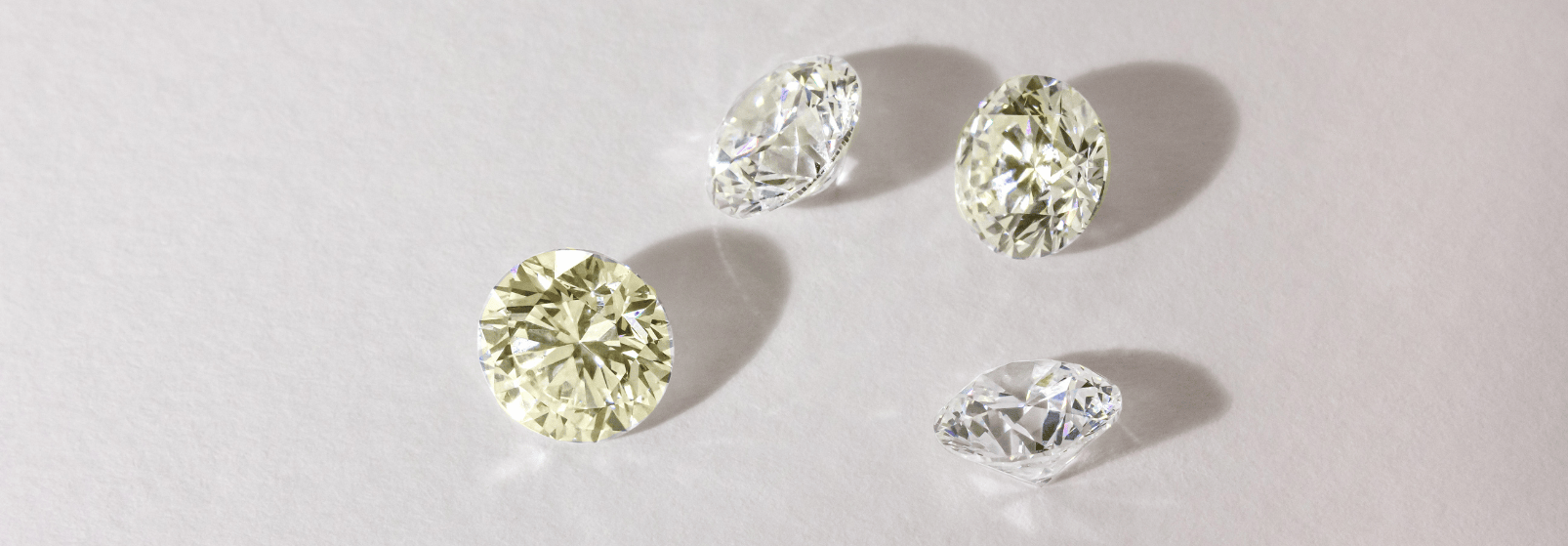
Let's start simple. Diamond colour describes the presence of colour in the stone. Counterintuitively, "colourless" doesn't mean perfect in some abstract sense. It means the stone lacks the faint yellow or brownish undertones that accompany most diamonds. Blame those on trace elements, bits of stuff that got locked in during formation, buried under insane pressure and heat for millions of years. That's where the colour comes from.
Every diamond carries a story. Go back millions of years. Insane heat. Crushing pressure. Deep within the Earth's guts, carbon transforms into diamonds. Some got contaminated during the process, and impurities sneaked in. Others stayed clean. That luck of the draw? It's literally why some diamonds look white and others carry that yellowish warmth.

The Gemological Institute of America (GIA) built a global colour standard to keep grading consistent. Without it, comparisons become difficult. One grader sees white. Another sees yellow. A universal standard matters.
Most diamonds fall into the "normal" colour range (what we call white diamonds). Beyond that sit fancy coloured diamonds: pinks, blues, yellows. Those follow completely different rules and cost a fortune. For engagement rings and everyday wear, the standard colour scale is what matters.
Here's something that doesn't get said enough. A diamond's emotional impact doesn't live in the grades alone. It lives in how you feel when you see it on your hand. Understanding diamond colour is step one. Feeling connected to your choice is step two.
The GIA 4Cs and the Colour Scale
The Gemological Institute of America (GIA) 4Cs form the backbone of diamond quality. Each component matters. Each one gets its own grade. Colour specifically gets compared to master stones under controlled light conditions. Rigorous? Absolutely. But it creates consistency across the industry.
The GIA colour scale has 23 grades split into five buckets:
Colourless (D-F): Zero visible colour. These diamonds are chemically pure or nearly so. D-colour stones sit at the absolute top. E and F diamonds? Still colourless. Still exceptional. Still cost less than D. The value proposition here is real.
Near Colourless (G-J): Slight colour. Key word: slight. The difference between grades is so minimal that untrained eyes won't catch it. G and H look completely white. I and J have a touch of warmth but most people miss it entirely. These colour grades are where smart buyers live.
Faint to Light (K-Z): Colour becomes more obvious, especially in larger stones. More character, less cost. Not the standard for engagement rings, but they have their place.

Each grade on that 23-step ladder represents a specific point. Move up, pay more. Move down, save serious money. The trick is knowing where the visual differences actually disappear.
How Diamond Colour Affects Beauty
This is where reality diverges from the lab report. Big time.

When a gemmologist grades your diamond, they examine it face down using master stones under controlled lighting. It's the most rigorous assessment possible. Perfectly scientific. Then you put that same diamond on your hand in daylight, and something shifts.
The brilliant facets of a well-cut diamond bounce white light around so aggressively that colour tints get masked. A diamond that showed warmth in the lab? Looks completely white when mounted and worn. Cut quality matters infinitely more than colour for how sparkly your stone appears. That's not an opinion, that's physics.
Fluorescence is the plot twist nobody expects. About 30% of diamonds do it. They glow under UV light, usually blue. Here's the thing: natural daylight contains UV radiation. So when you step outside wearing your diamond, that fluorescence kicks in and makes the stone look whiter and brighter than the lab ever showed you. Free upgrade just from going outside. Genuinely useful.
For pink diamonds or blue diamonds, fluorescence works differently and creates its own grading complexity. But for standard white diamonds, it often works in your favour.
The Gemological Institute of America (GIA) 4Cs don't exist independently. They interact. A well-cut H-colour diamond will blow away a poorly cut D-colour stone every single time. Colour is just one piece of a much larger puzzle.
Diamond Colour Grades and Settings
Here's something jewellers know but rarely explain clearly: your metal choice influences colour perception more than most people realise.
Platinum and white gold? Neutral backdrops. They let your diamond be the star without adding their own tint. Yellow gold and rose gold are different animals entirely. They introduce warmth. An H-colour diamond in platinum looks noticeably whiter than the exact same H-colour diamond in yellow gold.
The metal frames the stone. It sets the mood. Same diamond, two different metals, two completely different visual impressions.
This means you can get away with a slightly lower colour grade if you pair it with cool metal. An I-colour diamond in white platinum might look as white as an H-colour in yellow gold. Your eyes won't register the technical difference because the setting compensated for it.
Think about it strategically. A mediocre colour grade in warm yellow metal gets exposed immediately. That same grade in platinum? Invisible. This is leverage. This is where smart selection happens.

Choosing Your Diamond Colour Grade
There's no universal "best" grade. It depends on you: your budget, your setting preference, and what actually moves you visually.
If you want total confidence: D, E, or F. These are completely colourless. Investment-grade stones. You pay for that certainty, and if it matters to you, the peace of mind is real. F-colour diamonds specifically sit in a sweet spot within the colourless range, all the purity with slightly more breathing room than D or E.

If you're practical, G through J makes sense. Most people recommend engagement rings and land here. The colour differences between adjacent grades are so subtle your eye won't catch them. Once it's set in white metal? Even trained graders would struggle to tell them apart. You get whiteness without the premium.
If you want to prioritise differently, K and lower start showing more yellow or brown tint. You can see it. But ugly? Not really. Pair a K-colour with excellent cut and the right metal and suddenly you've got something genuinely special. These diamonds have character. Some people prefer putting their resources toward a larger stone or a better cut instead, and that's a valid choice.
The thing that actually matters though. Go see diamonds in person. Different grades. Different lighting situations. Daylight outside. The shop lights. Whatever you can get. Your eyes need to decide, not a certificate. What you feel when you look at it beats any lab report.
Key Takeaways
• The GIA colour scale exists, and it's solid, but those tiny grade differences? They disappear the moment your stone goes on your finger.
• D through F are colourless. G through J look identical to your eye. This is why price drops so dramatically at grade J.
• Lab grading and real-world appearance are different animals. Your diamond will look whiter and more brilliant when you're wearing it.
• Metal choice does heavy lifting. White settings enhance colourlessness. Warm settings amplify tint.
• Pick a colour grade aligned with your actual vision, not some imaginary standard. Your lifestyle and personal style matter as much as the grade itself. Consider consulting with our team to explore what works for you.
• The 4Cs work together as a system. Colour alone doesn't determine beauty. Cut does. Clarity does. They all contribute.
FAQ's
What separates D-colour from H-colour diamonds, really?
D, E, F are colourless. That's the label. G through J are near-colourless and honestly, if you're looking at them set in a ring on your hand, you're not going to see the difference. Your eye just won't catch it. But the investment part? That shifts. So it's more about what you want to prioritise with your money.
Can you actually spot colour in an H-colour stone?
In a lab with master stones right next to it and controlled lighting? Yeah, a grader trained for years might see a touch of warmth. Put that same stone on your finger though. Regular daylight. White metal. It vanishes. The whole thing looks white. It's wild how much the setting and lighting change what you're actually seeing versus what the report says.
Is colourless always better?
No. Rarer, sure. But when it's mounted? A near-colourless diamond looks identical. A lot of people realise they'd rather put that money somewhere else. Better cut. More carat. Whatever feels right to them. It's personal.
Which colour grade shows up most in engagement rings?
G through J. You see them everywhere. They're white looking. They feel like the obvious choice without being the most expensive choice. Makes sense why people land there.

What separates D-colour from H-colour diamonds, really?
D, E, F are colourless. That's the label. G through J are near-colourless and honestly, if you're looking at them set in a ring on your hand, you're not going to see the difference. Your eye just won't catch it. But the investment part? That shifts. So it's more about what you want to prioritise with your money.
Can you actually spot colour in an H-colour stone?
In a lab with master stones right next to it and controlled lighting? Yeah, a grader trained for years might see a touch of warmth. Put that same stone on your finger though. Regular daylight. White metal. It vanishes. The whole thing looks white. It's wild how much the setting and lighting change what you're actually seeing versus what the report says.
Is colourless always better?
No. Rarer, sure. But when it's mounted? A near-colourless diamond looks identical. A lot of people realise they'd rather put that money somewhere else. Better cut. More carat. Whatever feels right to them. It's personal.
Which colour grade shows up most in engagement rings?
G through J. You see them everywhere. They're white looking. They feel like the obvious choice without being the most expensive choice. Makes sense why people land there.




Need help choosing ?
We're happy to help